

What Are Medical-Grade Skincare Products and Why They Matter

Skincare labels often create confusion, especially when terms like medical grade skincare appear beside everyday skincare products. Many shoppers struggle to understand what separates higher strength formulas from items found on regular store shelves. Clear information helps people avoid guesswork and make choices based on real needs rather than marketing claims.
Interest in product strength and ingredient quality continues to grow as expectations around results increase. Professional skincare products attract attention because they promise targeted support for concerns such as uneven tone, breakouts, or visible aging. Curiosity often stems from wanting products that work without unnecessary complexity.
Beginners and experienced skincare users both benefit from simple explanations and honest comparisons. Focus here stays on education, clarity, and practical insight, not selling or prescribing. Accurate knowledge allows better decisions and more confidence when building a skincare routine.
What Are Medical-Grade Skincare Products?
Medical grade skincare products describe advanced topical formulas created to support visible skin improvement through focused ingredient use. Medical grade skincare does not require a prescription, yet development standards remain higher than many everyday options.
Clinical skincare products focus on performance driven skincare product formulation rather than scent, color, or packaging appeal. Ingredient selection relies on research and testing to support how skin responds with consistent use over time.
Formulators design these products to address specific skin concerns such as uneven tone, acne prone skin, early aging signs, or texture issues. Stronger ingredients require careful balance so skin benefits without unnecessary irritation. Quality control and ingredient stability play a central role in how these formulas perform on the skin.
Higher active ingredient levels
Concentrations exceed many store bought products to support noticeable improvement over time.
Targeted skin concern focus
Formulas aim at specific needs like clarity, firmness, or texture instead of general surface care.
Advanced formulation and delivery
Ingredient structure supports better absorption and controlled interaction with the skin.
What’s the Difference Between Medical-Grade and Over-the-Counter Skincare?
Understanding differences between medical grade options and over the counter skincare helps protect skin health and improves results. Product design affects how ingredients behave on skin, how deeply formulas work, and how safely routines perform over time. Clear comparison reduces irritation risk and limits wasted spending on products that fail to meet skin needs.
Over the counter skincare focuses on broad appeal and ease of use. Medical grade formulas focus on performance, structure, and controlled results. Skincare strength and potency vary widely between both categories, which explains why outcomes often differ even with consistent use.
Ingredient potency and effectiveness
Medical grade products use higher levels of active ingredients in skincare, while store options rely on lower concentrations for general tolerance.Depth of skin penetration
Medical grade formulations support deeper interaction with skin layers, while over the counter skincare works mainly at surface level.Product claims and testing standards
Medical grade products follow stricter testing and formulation rules, while store products prioritize marketing language over measurable outcomes.
Why Do Medical-Grade Skincare Products Matter?
Stronger formulas often produce clearer and more reliable results when skin concerns demand more than surface care. Dermatologist recommended skincare focuses on ingredient strength, balance, and precision to support visible improvement over time. Well designed skincare products work with skin biology rather than masking concerns through temporary effects.
Long term skin health depends on consistency, ingredient quality, and proper formulation. Short term cosmetic fixes may improve appearance for a few hours, yet skin structure and function require steady support. Focus on skin barrier health helps maintain moisture balance, reduce irritation risk, and improve how skin responds to active ingredients. Informed choices allow routines to adapt as skin changes with age, environment, or lifestyle.
Targeted concern improvement
Formulas support visible changes in aging signs, breakouts, or uneven tone through focused ingredient use.
Reliable performance over time
Consistent formulation standards support predictable results instead of trial and error outcomes.
Stronger skin barrier support
Proper use helps reinforce moisture retention and resilience while reducing sensitivity risk.
Who Should Consider Medical-Grade Skincare Products?
Medical grade skincare suits many routines but does not fit every skin type or goal. Guidance helps match product strength with real needs instead of trends or pressure.
Professional skincare products often support users who want clearer results and more structure in daily care. Thoughtful selection matters more than intensity, especially for sensitive or reactive skin.
People facing limited results from store bought options
Lack of visible change after consistent use may signal a need for stronger formulations within skincare products.
Beginners seeking clarity and direction
Simple routines with proven formulas help reduce confusion and improve confidence during early skincare decisions.
Ingredient focused consumers
Interest in research backed ingredients often leads to medical grade skincare due to clearer formulation standards.
Common Misconceptions About Medical-Grade Skincare
Confusion around medical grade products often leads to hesitation or misuse. Clear explanations help set realistic expectations and promote responsible choices. Balanced information supports better outcomes and safer routines.
Medical grade means prescription only
Medical grade products differ from prescription vs non prescription skincare. Many options remain available without a prescription while still offering higher formulation standards.
Stronger products always deliver better results
Skincare strength must match skin tolerance and goals. Excess potency may trigger irritation without improving outcomes. Smart selection matters more than maximum intensity.
Daily use causes damage or sensitivity
Consistent use can work well when routines respect skin limits. Proper application frequency supports steady improvement and comfort.
Medical grade products replace basic skincare
Cleansers, moisturizers, and sun care still play essential roles. Medical grade products complement routines rather than replace foundational steps.
Clear Results, Smarter Skincare Choices
Medical grade skincare helps clarify choices for anyone seeking reliable results from daily care. Stronger formulas work best when people understand why products exist and how ingredients support skin function. Skincare products deliver better outcomes when selection relies on purpose rather than trends or quick promises.
Product formulation plays a key role in comfort and progress over time. Informed skincare choices reduce trial and error while supporting balance, tolerance, and consistency. Skin responds well to routines built around steady habits and ingredient awareness instead of frequent changes.
A natural skincare mindset values patience, education, and respect for skin limits. Thoughtful routines support long term health and confidence when care feels intentional and simple. Consider reviewing product needs carefully and choose options that align with personal goals and daily life, and take time to speak with a skincare professional when guidance feels helpful.
FAQs
Are medical grade skincare products safe for daily use?
Daily use works well when product strength matches skin tolerance and routine design stays simple. Proper application frequency and supportive basics like cleansing and moisture help maintain comfort and balance.
Do medical grade skincare products require a prescription?
Most medical grade options remain available without prescriptions. Difference comes from formulation standards and ingredient quality rather than legal restriction.
Can sensitive skin use medical grade skincare?
Sensitive skin can respond well with careful selection and gradual use. Lower strength formulas and supportive ingredients help reduce irritation risk.
How long does it take to notice results?
Visible improvement often appears after several weeks of consistent use. Skin renewal cycles and concern type influence timing.
Can medical grade skincare replace basic routine steps?
Cleansing, moisturizing, and sun protection remain essential. Advanced products work best when combined with simple daily care habits.
Why Women in Tifton Are Turning to Dermal Fillers to Look Rested — Not Different
There is a shift happening in aesthetic medicine, and women in Tifton are right in the middle of it.
Forget the overfilled lips and frozen faces that dominated filler culture a decade ago. Today, the goal most patients walk in with sounds more like this: "I just want to look like myself again — but less tired."
Dermal fillers have become one of the most requested treatments at med spas across South Georgia, and the reason is not vanity. For most women, it is something far more practical. Mirrors started telling a story that did not match how they feel on the inside. Volume quietly disappeared from their cheeks. Hollows formed under their eyes. Smile lines deepened. And no amount of concealer or sleep seemed to fix it.
Fillers, when done well, fix that. Subtly, naturally, and without anyone being able to point to exactly what changed.
What Dermal Fillers Actually Do
Dermal fillers are injectable gels, most commonly made from hyaluronic acid, a substance your body already produces naturally. Hyaluronic acid holds moisture and gives skin its plump, cushioned look. Starting in your late 20s and accelerating through your 30s and 40s, your body produces less of it. Collagen and fat volume follow the same path downward.
Fillers replace what time removes. A skilled injector places small amounts of product in precise locations to restore lost volume, smooth folds, and lift areas that have started to sag or hollow.
Common treatment areas include:
Under-eye hollows (tear troughs)
Cheeks and midface
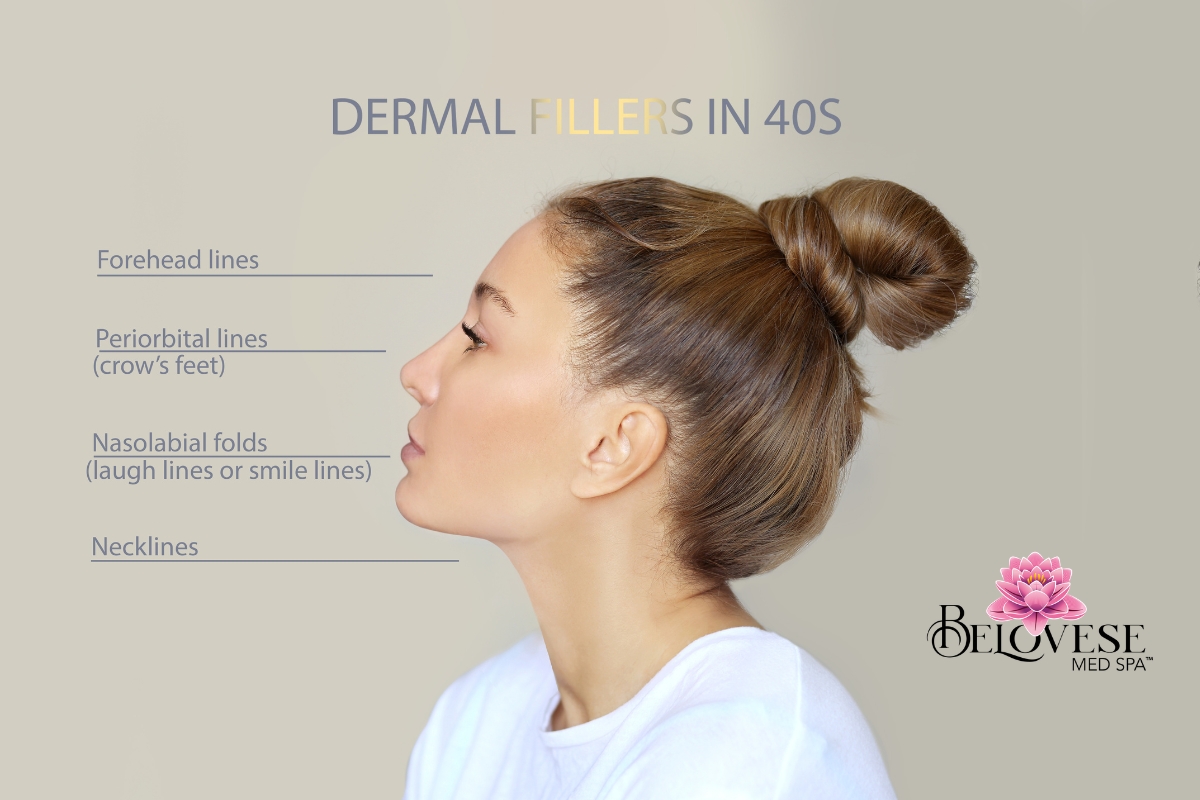
Nasolabial folds (the lines from nose to mouth)
Lips (for volume and definition, not just size)
Jawline and chin
Temples
Results are immediate and, depending on the product used, typically last 9 to 18 months. No surgery, no general anesthesia, no recovery week.
The "Rested, Not Different" Philosophy
Walk into most consultations atBelovese Med Spa today and you will hear a version of the same sentence: "I do not want to look like I had anything done."
That single sentence has reshaped how skilled injectors approach filler treatment. Rather than chasing a specific feature enhancement, the focus now is on restoring balance and proportion so the face simply looks refreshed.
Overcorrection is what creates the telltale "filler face" look. Too much product, placed too superficially or in the wrong plane, pushes the face outward instead of lifting it. A conservative, anatomy-first approach does the opposite. It adds back what is missing without announcing itself.
Sherri Crosby, APRN-FNP-C at Belovese Med Spa approaches every filler consultation by studying the face as a whole before recommending a single unit of product. Where has volume shifted? What has drooped? What is casting shadow that did not used to? That assessment drives the treatment plan, not a standard menu.
Why Tifton Women Specifically Are Seeking This Out
South Georgia living is beautiful, but it is not always kind to skin. High humidity, intense UV exposure for most of the year, and the physical demands of active, busy lives accelerate the natural aging process.
Women in Tifton are also increasingly informed. Social media has made filler results more visible than ever, and patients arrive at consultations having already studied before-and-after photos, watched procedure videos, and read reviews. What they want is clear: results that look natural, a provider they can trust, and a clinic close enough to make maintenance appointments realistic.
Driving two hours to Atlanta for a filler appointment is not sustainable. Having a credentialed medical injector in Tifton who knows your face over time is.
That continuity matters more than most patients realize at first. An injector who has seen your face across multiple appointments understands how your skin ages, how product settles in your specific anatomy, and when to add versus when to wait. That relationship produces better long-term results than seeing a different provider every visit.
The Most Common Concerns Fillers Address
Under-Eye Hollows and Dark Circles
One of the most transformative filler treatments is also one of the most underused: tear trough filler. The hollow that forms between the lower eyelid and the cheek creates a persistent shadow that reads as fatigue regardless of how much sleep you have gotten.
Placing a small amount of soft hyaluronic acid filler in this area lifts the shadow, smooths the transition between the eye and cheek, and produces the single biggest "you look so rested" response of any injectable treatment.
Cheek Volume Loss
Flat or deflated cheeks age the face significantly because volume loss here causes the skin above to sag and the nasolabial folds below to deepen. Restoring midface volume with filler lifts multiple areas at once without touching any of them directly. It is one of the most efficient treatments available.
Lip Lines and Lip Volume
Lip filler today bears little resemblance to the overfilled results of the early 2010s. Most patients seeking lip treatment want subtle definition, improved symmetry, or a small boost in volume, not a dramatic change in size. Addressing the fine vertical lines above the lip border is equally common, especially in patients over 40.
Jawline and Chin Definition
Structural fillers placed along the jawline and chin create definition that fights the soft, undefined look that develops as bone density decreases with age. For women who have never had a strong jawline, this treatment can reshape facial proportion in a way that reads as simply attractive rather than obviously treated.
What a Filler Consultation at Belovese Looks Like
Booking aninjectable treatment at Belovese starts with a conversation, not a needle.
Your consultation will cover:
What bothers you most about your current appearance and what you want to feel like after treatment
A full facial assessment under good lighting to identify volume loss patterns, asymmetries, and skin quality
A plain-language recommendation of which areas to treat, in what order, and why
Honest discussion of how much product is appropriate versus how much would be too much
Pricing transparency so you leave knowing exactly what your treatment will cost
First-time filler patients are often surprised that the consultation feels more like a thoughtful conversation than a sales pitch. At Belovese, the goal is for you to leave your appointment looking like you, just on a very good day.
Addressing the Fears Most Women Have Before Their First Appointment
Fear of pain, fear of looking overdone, and fear of something going wrong are the three concerns that keep most first-timers from booking. All three are worth addressing honestly.
Pain: Most filler products contain lidocaine, a local anesthetic, built directly into the formula. Combined with topical numbing cream applied before treatment, the vast majority of patients describe discomfort as mild and brief. Some areas, particularly the lips, are more sensitive than others.
Looking overdone: Choosing a conservative, anatomy-trained injector is the single best protection against this outcome. Starting with less product than you think you need and building gradually across appointments is standard practice at reputable clinics. You can always add; removal requires a dissolving agent.
Safety: Hyaluronic acid fillers are reversible. If a result is uneven, asymmetrical, or simply not what you wanted, an enzyme called hyaluronidase dissolves the product quickly. Serious complications from filler are rare but real, which is why treatment by a medically trained provider in a clinical setting matters significantly more than price shopping at a non-medical facility.
How Fillers Fit Into a Broader Wellness Approach
Fillers do not exist in isolation for most Belovese patients. Many women combine filler treatments with Botox for dynamic wrinkles,professional skin treatments like facials and chemical peels to improve skin quality, andmedical-grade skincare products to maintain results between appointments.
For patients managing hormonal changes, pairing aesthetic treatments withhormone therapy can also support skin health from the inside. Estrogen plays a direct role in collagen production and skin thickness. Patients who address both layers — external and internal — often maintain better results with less product over time.
How Long Do Results Last and What Does Maintenance Look Like?
Most hyaluronic acid fillers last between 9 and 18 months depending on the area treated, the product used, and individual metabolism. Lips tend to metabolize product faster. Cheeks and jawline typically hold results longer.
Maintenance appointments are usually shorter and require less product than the original treatment because the injector is refreshing rather than rebuilding. Many Belovese patients find that their maintenance costs decrease over time as they reach a stable baseline and simply top up strategically.
Planning your filler appointments is also worth thinking about seasonally. If you have a wedding, reunion, or major event on the calendar, scheduling treatment 2 to 4 weeks in advance gives any minor swelling time to resolve and lets results settle into their final, natural appearance.
Frequently Asked Questions
How much do dermal fillers cost in Tifton, GA?
Filler pricing varies based on the product used and the number of syringes required. At Belovese Med Spa, pricing is discussed transparently during your consultation so there are no surprises.Contact us for current pricing information.
Will dermal fillers make me look unnatural?
Not when placed conservatively by a trained injector. Natural results come from understanding facial anatomy, using the right product in the right plane, and avoiding overcorrection. Starting with a modest amount and building over time is always the safest approach.
Is there downtime after dermal filler treatment?
Most patients return to normal activity the same day. Mild swelling and occasional bruising are possible, particularly around the lips and under eyes, and typically resolve within 3 to 7 days. Avoiding blood-thinning supplements like fish oil and vitamin E for a week before treatment reduces bruising risk.
At what age should women consider dermal fillers?
There is no fixed age. Most patients begin noticing volume loss in their mid-30s to early 40s, though some start earlier for lip definition or symmetry. A consultation will give you a clear picture of whether treatment makes sense for you right now.
Can I combine fillers with Botox at the same appointment?
Yes, and many patients do. Botox addresses dynamic wrinkles caused by muscle movement while fillers restore lost volume. Together they complement each other and can reduce the total amount of each product needed.
Conclusion
Looking rested is not a superficial goal. It affects how you feel walking into a meeting, how you look in family photos, and how closely your outside matches your inside on an average Tuesday.
Dermal fillers, placed thoughtfully by a medically trained injector, are one of the most effective tools available for closing that gap without changing who you are. Women in Tifton are figuring that out, one appointment at a time.
If you have been curious but hesitant, a no-pressure consultation at Belovese Med Spa is the best place to start. Ask every question you have, see what is actually possible for your face, and leave with a plan that feels right, not rushed.
Book your free dermal filler consultation at Belovese Med Spa today.

COMPANY
SERVICES
ADDRESS


COMPANY
SERVICES
ADDRESS
Copyright 2026. Belovese Med Spa. All Rights Reserved.
Made with ❤️by The Revive Agency.